News · 03 November, 2026
Japan's qualified invoice rule from October 2026: 70% for suppliers without a T-number
Since 1 October 2026, Japanese buyers recover only 70% of the consumption tax on purchases from unregistered suppliers. For a K.K. in its first two years, the question of registering has become more pressing.
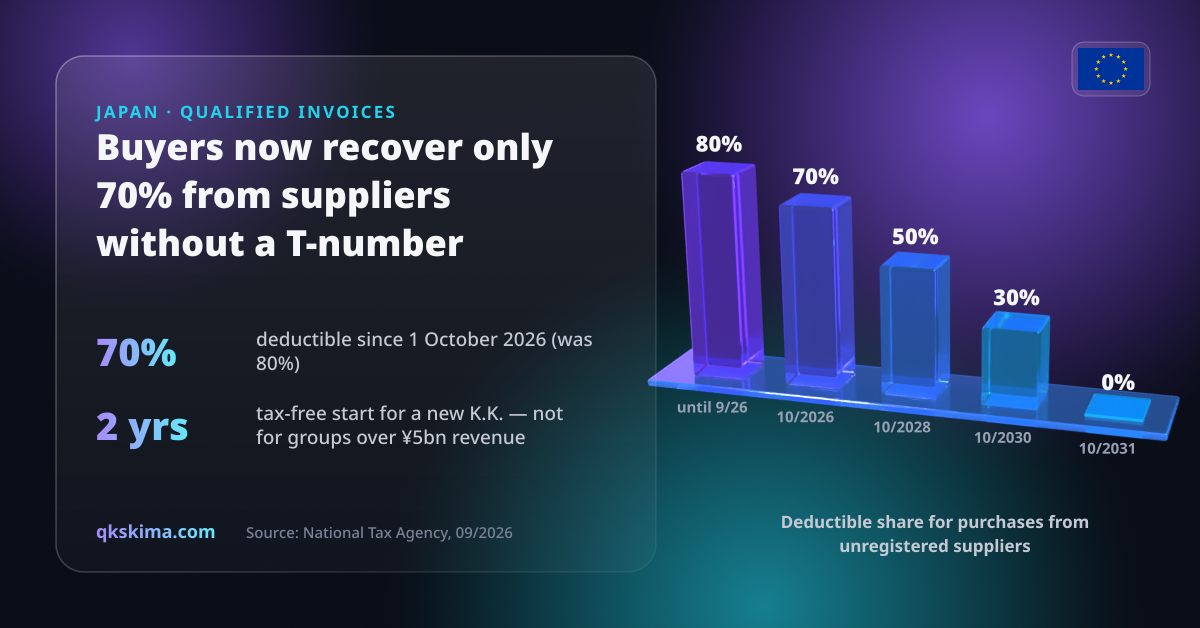
On 1 October 2026 the transitional rule of Japan's qualified invoice system moved to its next step. A Japanese business that buys from a supplier without a qualified invoice issuer registration (the T-number) can now deduct only 70% of the consumption tax on that purchase, down from 80%. The National Tax Agency has published the schedule: 50% from 1 October 2028, 30% from 1 October 2030, and no deduction at all from 1 October 2031.
Who this affects most are young Japanese entities of European companies. A K.K. or G.K. with capital under 10 million yen usually has no base period in its first two years and is therefore exempt from consumption tax. Many stay unregistered to keep that exemption. It was a reasonable choice while the customer could still recover 80%. Now every unregistered invoice costs a Japanese customer more, and the gap widens every two years.
Two further changes affect the decision. First, the so-called 20% special rule has ended. It let businesses that registered out of exemption pay only 20% of the tax on their sales. It applies only up to the tax period that includes 30 September 2026. Second, the exemption for new entities has narrower limits than many assume. Since tax periods starting on or after 1 October 2024, a newly established entity is not exempt if it belongs to a group whose total sales and other revenue exceed 5 billion yen. The test counts revenue worldwide, not only in Japan. A small capital alone no longer guarantees the two exempt years.
What this means in practice depends on your situation, and the decision belongs to your tax adviser: register now, register later, or stay exempt and accept that some customers will ask for a price adjustment. Once registered, an entity loses its exemption from that point on.
The technical side follows from that decision and is often underestimated. A qualified invoice must show the registration number, the tax amount for each rate (10% and 8%) and the other required details. If invoices come from the parent company's ERP, a European billing platform or a SaaS product, those systems have to produce Japanese invoices that meet the rules. That also applies to credit notes and to invoices kept electronically under the Electronic Books Maintenance Act. Templates made for Europe rarely do this by default.
What remains open is how individual customers react to the lower deduction. That will vary by industry and by how much of a buyer's spend goes to unregistered suppliers.
We adapt invoicing, billing and shop systems so they produce qualified invoices for Japan; the tax questions stay with your adviser.
Sources