Guides for companies in Japan · Invoicing in Japan
Your Japanese customers ask for your T-number — and your invoice doesn't have one
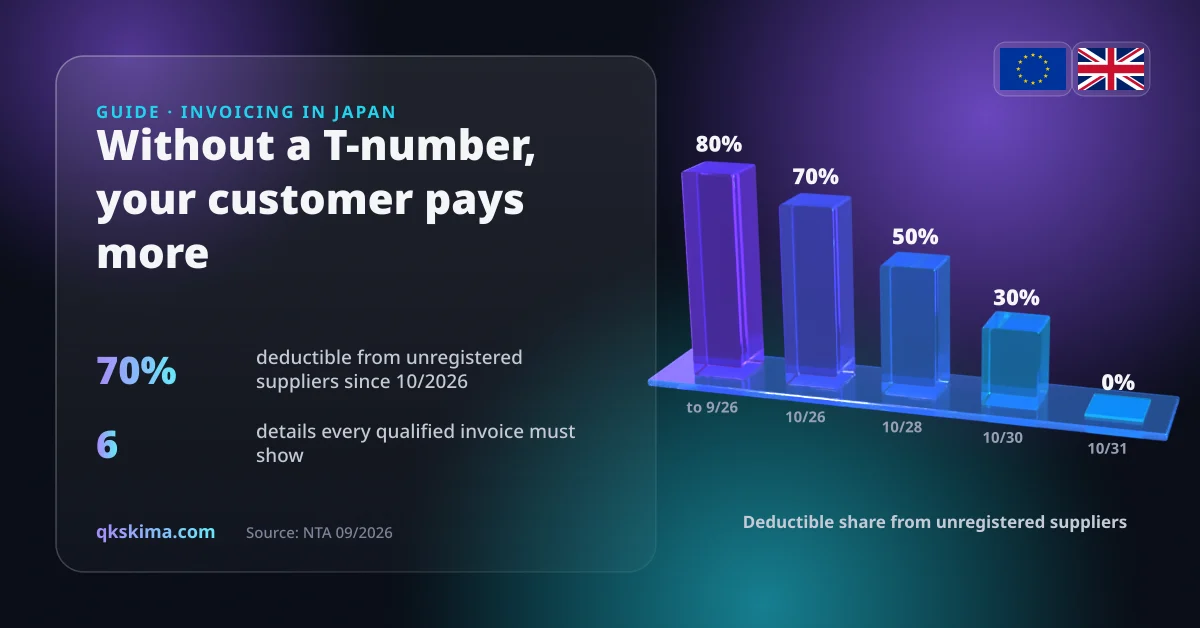
Since 1 October 2023, Japanese companies deduct the full consumption tax only if they receive a qualified invoice with a registration number (T-number). For unregistered suppliers a transitional rule is phasing out: since 1 October 2026 only 70% is deductible, 50% from October 2028, 30% from October 2030, nothing from October 2031. For a European company in Japan this means: your tax adviser settles the registration, then your invoice template, shop, billing system or ERP has to deliver the required details.
Does this sound familiar?
- Japanese customers ask for your T-number when they register you as a supplier.
- Your invoices come from head office's ERP or billing system and don't show tax per rate.
- A customer asks for a discount because they can't fully deduct your invoice.
- Credit notes and corrections are still made by hand.
- Nobody knows whether your shop or SaaS billing can produce Japanese invoices.
Why this happens
The deduction depends on the invoice
Without a qualified invoice, the Japanese customer bears part of the consumption tax. With each step of the transitional rule, an unregistered supplier becomes more expensive.
The systems were built for Europe
Invoice templates and ERP forms are made for European VAT. Registration number, tax per rate and Japanese details are usually missing.
New entities are often exempt
A new K.K. or G.K. with capital under ¥10 million is usually exempt from consumption tax for two years. Registering as an invoice issuer ends the exemption — and since October 2024 it does not apply to entities of large groups anyway.
Responsibilities are split
The tax adviser decides on registration, head office IT on the systems. The implementation easily falls between the two.
What to do now
-
1
Settle registration with your tax adviser
Register now, later or not at all? The answer depends on your customers, revenue and group size.
-
2
List everything that produces invoices
Invoice template, shop, subscription or SaaS billing, head office ERP, credit notes: every source has to deliver the required details.
-
3
Build in the required details
Name and registration number, date, items with reduced-rate items marked, totals and rate per tax rate, tax per rate, recipient's name.
-
4
Test with real cases
Run through mixed tax rates, discounts, credit notes and part payments before the first invoice goes to a customer.
-
5
Settle record keeping
Invoices you send or receive electronically have to be kept in order and searchable under Japanese law. Your tax adviser sets the framework.
Checklist: what a qualified invoice must show
- Issuer's name and registration number (T-number)
- Date of the transaction
- What was supplied, with reduced-rate items marked
- Total per tax rate (10% and 8%) and the rate applied
- Consumption tax per tax rate
- Recipient's name
How we help
QkSkima K.K. is a Japanese company in Kitakyushu. We implement what your tax adviser decides: in your invoice template, shop, SaaS billing or the interface to head office's ERP.
- Invoice templates and credit notes with all required details, in Japanese and bilingual on request
- Shop (Shopware, Magento and others) and SaaS billing ready for Japan: tax per rate, bank transfer on invoice
- Connection to head office's ERP or billing system, so Japan doesn't become an island
- Tests with real cases: mixed tax rates, discounts, corrections
- Coordination with your tax adviser in Japan — in English or German with head office, in Japanese in writing in Japan
Frequently asked questions
Do we need a T-number?
Your tax adviser decides. For customers who deduct consumption tax, an invoice without a T-number has been only 70% deductible since 1 October 2026, and the share keeps falling.
Can invoices still come from head office's ERP?
Yes, if the system delivers the required details. Often an adapted template or a separate output for Japan is enough; sometimes a small invoicing setup in Japan is simpler.
Do you handle the registration?
No. Registration and tax assessment are for your tax adviser. We make sure your systems then produce the right invoices.
How long does it take?
An invoice template is often adapted in a few days. For a shop, SaaS billing or ERP connection we estimate after a short look at your system.